We want integration to give us some notion of (signed) as well as reversing differentiation, with the goal of building up the fundamental theorem of calculus.
B-C §41-43 (8 Ed §37-39)
Consider a \mathbb C-valued function of one real variable. That is, w(t) = u(t) + iv(t) for t \in \mathbb R. Define w'(t) = u'(t) + iv'(t).
The usual rules for real-valued differentiation apply:
We can also define definite and indefinite integrals for such functions. For a, b \in \mathbb R, \begin{aligned} \int_a^b w(t)\, dt &= \int_a^b u(t)\,dt + i\int_a^bv(t)\,dt \\ \operatorname{Re}\left(\int_a^b w(t)\,dt\right) &= \int_a^b \operatorname{Re}(w(t))\,dt \\ \operatorname{Im}\left(\int_a^b w(t)\,dt\right) &= \int_a^b \operatorname{Im}(w(t))\,dt \end{aligned} \int_0^\infty w(t)\,dt and similar can be defined analogously. The above expressions certainly make sense if w is continuous, that is w \in C^0([a,b]).
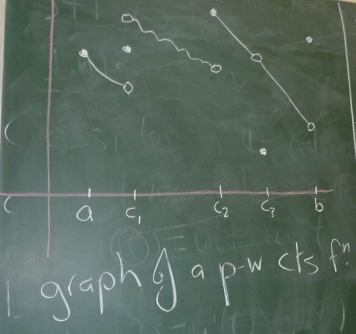
Somewhat more generally, it also holds for piecewise continuous functions on [a,b]. That is, w such that there exist c_1 < c_2 < \cdots < c_n \in (a,b) such that
Of course, the limits existing for w imply the limits exist for u and v.
Suppose there exists W(t) = U(t) + iV(t) such that W' = w on [a,b]. Then, the fundamental theorem of calculus holds, in the form of \int_a^b w(t)\,dt = W(b) - W(b). The next estimate is crucial.
Lemma. Suppose w = u+iv is piecewise continuous on [a,b]. Then, \left|\int_a^b w(t)\,dt\right|\le \int_a^b \left|w(t)\right|\,dt. Proof. If \int_a^b w(t)\,dt = 0, then the left is 0 and right is \ge 0 so we are done. Otherwise, there exists r > 0 and \theta_0 \in \mathbb R such that \int_a^b w(t)\,dt = re^{i\theta_0} which implies \left|\int_a^b w(t)\,dt\right| = r. Then, \begin{aligned} \int_a^b w(t)\,dt &= re^{i\theta_0}\\ \int_a^b e^{-i\theta_0} w(t)\,dt &= r\\ \implies r=\int_a^b e^{-i\theta_0} w(t)\,dt &=\operatorname{Re}\left(\int_a^b e^{-i\theta_0} w(t)\,dt\right) \\ &= \int_a^b \operatorname{Re}\left(e^{-i\theta_0}w(t)\right)\,dt \end{aligned} However, \operatorname{Re}\left(e^{-i\theta_0}w(t)\right) \le \left|e^{-i\theta_0}w(t)\right| = |w(t)| because \left|e^{-i\theta_0} \right|= 1. Combining this with the expression for \left|\int_a^b w(t)\,dt\right| = r from earlier, \left|\int_a^b w(t)\,dt\right| = r \le \int_a^b \operatorname{Re}\left(e^{-i\theta_0}w(t)\right)\,dt \le \int_a^b \left|w(t)\right|\,dt. \square
A contour is a parametrised curve in \mathbb C. Given x(t), y(t) continuous on [a,b] \to \mathbb R, z(t) = x(t) + iy(t), \quad a \le t \le b defines an arc in \mathbb C.
This is both a set of points z([z,b]), called the trace of the arc, and also a recipe for drawing the arc (the parametrisation).